
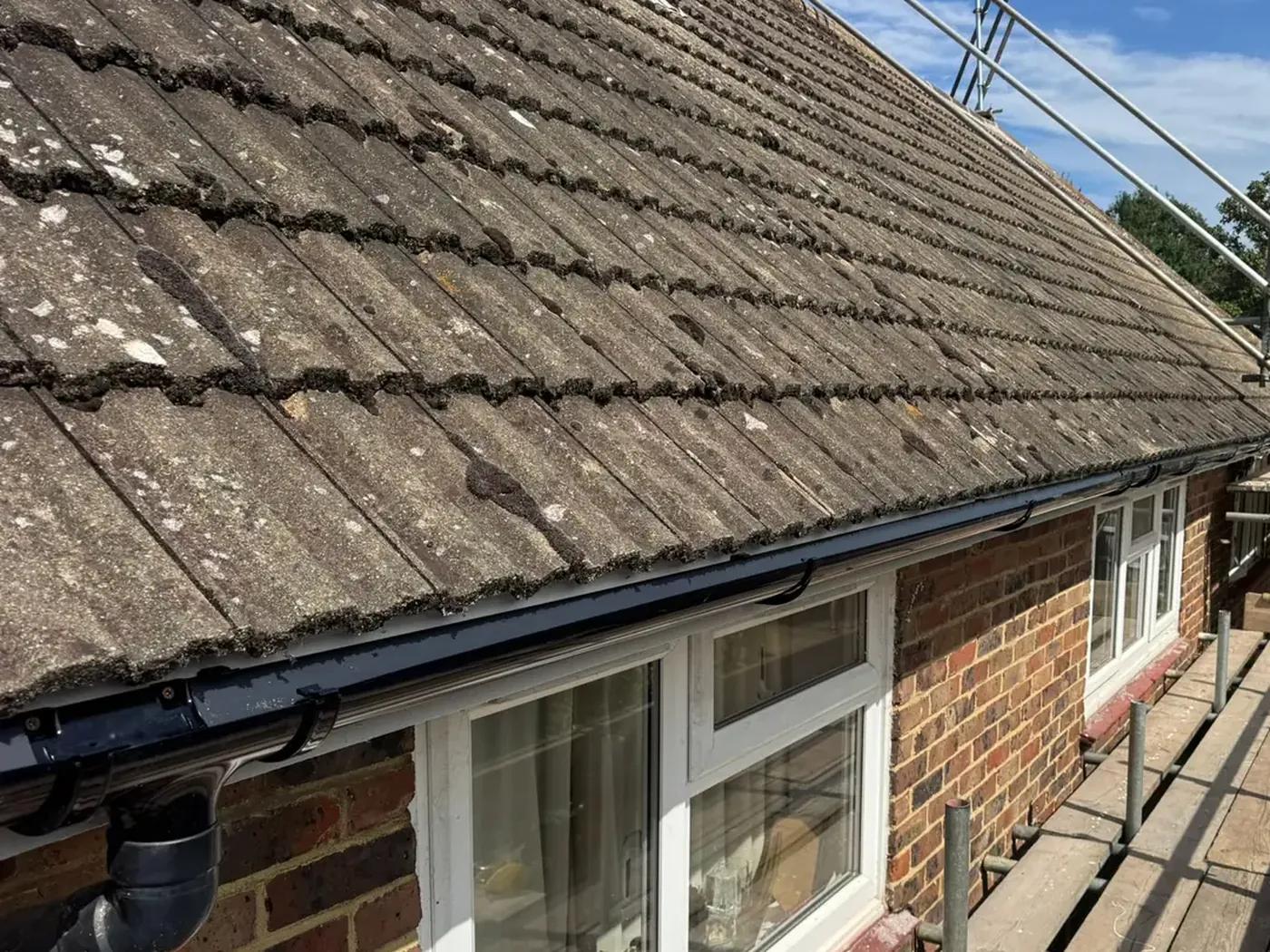
Most of the gutter calls I get along this part of the coast come in once the leaves are down and the rain has somewhere to go. A joint that only dripped in the summer is running down the wall. A run that looked level in August has a sag in it. Houses in Hove, Portslade, Southwick and Shoreham-by-Sea take more salt and wind than a house a few miles inland, and the small faults in a gutter show up together.
What the Coast Does to a Gutter
Salt air and driving rain off the Channel get into the joints, the brackets and the board behind the gutter. uPVC that has sat in the sun for years goes brittle. It stops flexing, and a fixing that moves can split it. The rubber seals in the joints perish, so a fitting that was tight starts to weep at the back, onto the wall underneath.
Cast iron is still on plenty of the older houses here. Once rust starts at a joint, or along the back edge where water sits against the fascia, it carries on. A rusty joint can be a repair. Rust along the back of the gutter, over a length of the run, usually means that piece has had its time.
Brackets fail quietly. One pulled fixing lets a section drop. Water sits in the low point, or spills over the front, and the rest of the run can still be sound.
What You Can See from the Street
You do not need a ladder for most of this. From the pavement I would look for:
- ✓A dark stain on the brick or render under a joint, or a tide mark where water has been running down the wall.
- ✓A gutter that dips, or that no longer falls towards the downpipe, so water sits in it.
- ✓A downpipe that has come apart at a connector, or a shoe at the bottom that has dropped away from the drain.
- ✓Moss, weeds or a line of silt in the gutter. That means it has been holding debris, and usually water, for a while.
- ✓A fascia or soffit that looks swollen, stained or cracked behind the gutter. If that board is soft, the gutter will not keep its fall.
One of those, on its own, is usually a small job. Several of them on the same house means the gutter has been overflowing for more than one winter, and the wall underneath is part of it by then.
A Clear-Out, a Repair, or a Replacement
If the gutter and the brackets are sound, and the trouble is leaves, moss and silt, clearing the run and flushing the downpipe is the job. I would do that before the wet months settle in.
A repair is the right job when the fault is in one place and the material around it is still sound. A perished seal, a bracket that has let go, a short split in plastic that is still flexible, a downpipe that has parted: those can be put right without taking the whole run off. I have written separately about how to tell a gutter repair from a replacement, and the same test applies on these houses.
Replacement is the honest answer when the plastic has gone brittle in more than one place, when the cast iron is rusting along the back of the run, or when the gutter sags because the brackets have failed one after another. If the fascia behind it is soft, a new gutter on that board will not hold its line, so the board needs doing at the same time. I will tell you that before the price is set.
Hove, Portslade, Southwick and Shoreham
In Hove, a lot of the houses are Victorian and Edwardian, with a long gutter on a big roof slope. That run has a lot of water to shift. If it has dropped, or the joints have opened, it overflows in a heavy downpour even when the leaves are out of it.
Portslade and Southwick are a mix of older terraces and later houses with concrete tiles. Cast iron is still there on some of the older streets. The later houses are mostly uPVC, and a lot of the joints on those runs are tired. Southwick sits between Portslade and Shoreham Harbour, so the salt in the air is much the same on streets that are not on the front.
Shoreham-by-Sea gets damp air off the sea and off the River Adur. Old Shoreham and the streets nearer the beach are both part of the same work: a joint, a sag, a downpipe, or a board that has gone soft.
I am a roofer and a builder, and gutters sit with the rest of the outside of the house. If a mark has come up indoors after heavy rain, and the tiles look intact from the street, I start with the gutter and the wall under it. There is more on that in the guide to building maintenance in Brighton and Hove.
Sorting It Before the Wall Stays Wet
November is a sensible time. The leaves are mostly down, so a gutter cleared now has a chance of staying clear, and a dry day is a better day to reseal a joint or refix a bracket. Leave a dripping joint through the winter and the wall under it stays damp.
Water from a gutter can travel. It runs down the outside, soaks the brick, and the damp mark indoors can sit some distance from the joint that is dripping. If you are not sure where the water is getting in, that is a sensible reason to ask someone to look.
If you want the gutters looked at, and a straight answer on a clear-out, a repair or a replacement, that is what our gutter repairs and replacement service is for. No job is too small. The quote is free, there is no call-out charge, we are fully insured, and the price is set out honestly before any work starts. I have been doing this work for more than 20 years. Kirby's Building & Property Maintenance Ltd covers Hove, Portslade, Southwick, Shoreham-by-Sea and the rest of the Sussex coast. Get in touch through the contact page, or call 07740 182032.